


Blog Details

Why Your Next CRM Move Should Be Strategy, not a System

In today’s complex business environment, organizations across industries face a critical challenge, the fragmented customer interactions across multiple channels and touchpoints. Whether managing direct relationships, partner ecosystems, or field operations, companies struggle with disconnected processes, siloed data and missed engagement opportunities. Rapid growth often worsens it, as organizational structures and processes can’t scale quickly enough to keep pace, creating gaps that undermine customer experience and operational effectiveness. This is where CRM Strategy and Blueprinting Services become essential.
When the CRM Strategy Services Make the Biggest Impact
Customer engagement goes beyond installing yet another tool, it is about rethinking how your people, partners and systems come together to make every interaction feel coherent and valuable. Organizations benefit most from our engagement strategy services when they face challenges such as:
- Greenfield Initiatives: New organizations, business units, or market expansions starting from zero that need to establish CRM strategy, processes and governance from the ground up, avoiding the mistakes others have made and building the foundations for future growth.
- Organizational Silos: Teams work in isolation, using different tools and manual fixes, so no one sees the whole customer story.
- System Fragmentation: A patchwork of legacy platforms across regions or units hides the full picture and makes coordinated outreach nearly impossible.
- Channel and Partner Visibility Gaps: Limited visibility into partner pipeline, deal progression and collaboration, whether through indirect channels or internal departments.
- Process Inefficiencies: Manual handoffs, duplicated work and unclear responsibilities slow response times and waste people’s effort.
- Weak Data Governance: Customer records, ownership and definitions vary by team, so reporting and decision making are unreliable.
- Strategic Misalignment: Technology projects get launched without a clear link to business goals, causing projects to lose momentum and miss their mark.
These challenges are not about team effort or tools alone. Great teams are already trying, but making engagement work takes more than technology. It requires alignment, clarity and intentional change management.
How We Work With You
We follow a phased, collaborative methodology designed to bridge vision and execution and help organizations move from fragmented operations to integrated, customer centric engagement.
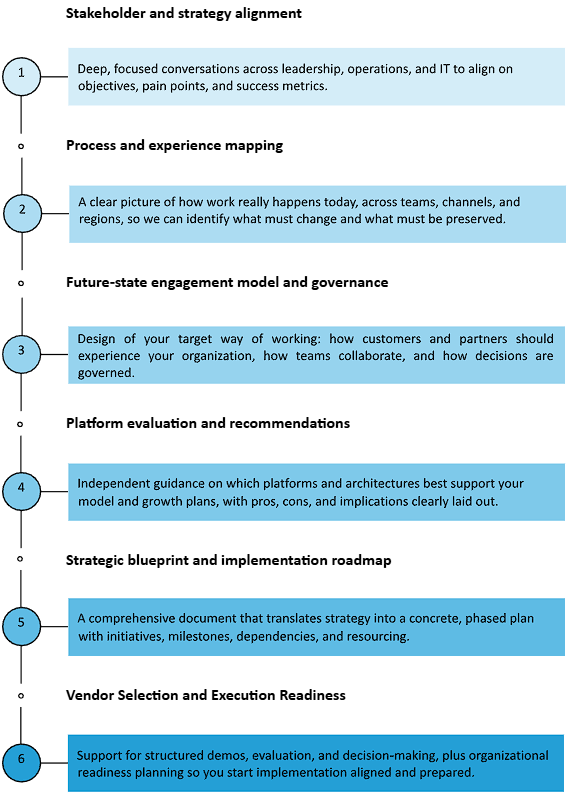
Each step is designed to reduce risk, build buy in, and maintain momentum, from the first conversation through to the start of delivery.
The Core Principles
Throughout our engagement we guide our approach by the following principles:
Alignment Precedes Architecture
Systems should follow process. Process should follow strategy. We start by aligning on strategic direction and operating model, ensuring all voices are heard, assumptions are challenged and consensus is built.
People and Process Before Technology
We clarify processes, roles and governance first, only then choose technology. Projects can be disrupted when teams haven’t aligned on how work will change, who’s responsible and how people will be supported.
Balanced Standardization
Don’t force one rigid solution or let every team do its own thing. Define a simple framework that fixes the essentials (core processes, master data, reporting, etc.) while allowing local teams to adapt configurations and minor workflow details to their context.
Integration by Design
Understanding data ownership, integration requirements and system dependencies early significantly reduces implementation complexity. Integration architecture is a core design consideration from the beginning.
Governance Enables Sustainability
Clear roles, decision rights and accountability from the start are the foundation for scaling without chaos.
Key Takeaways
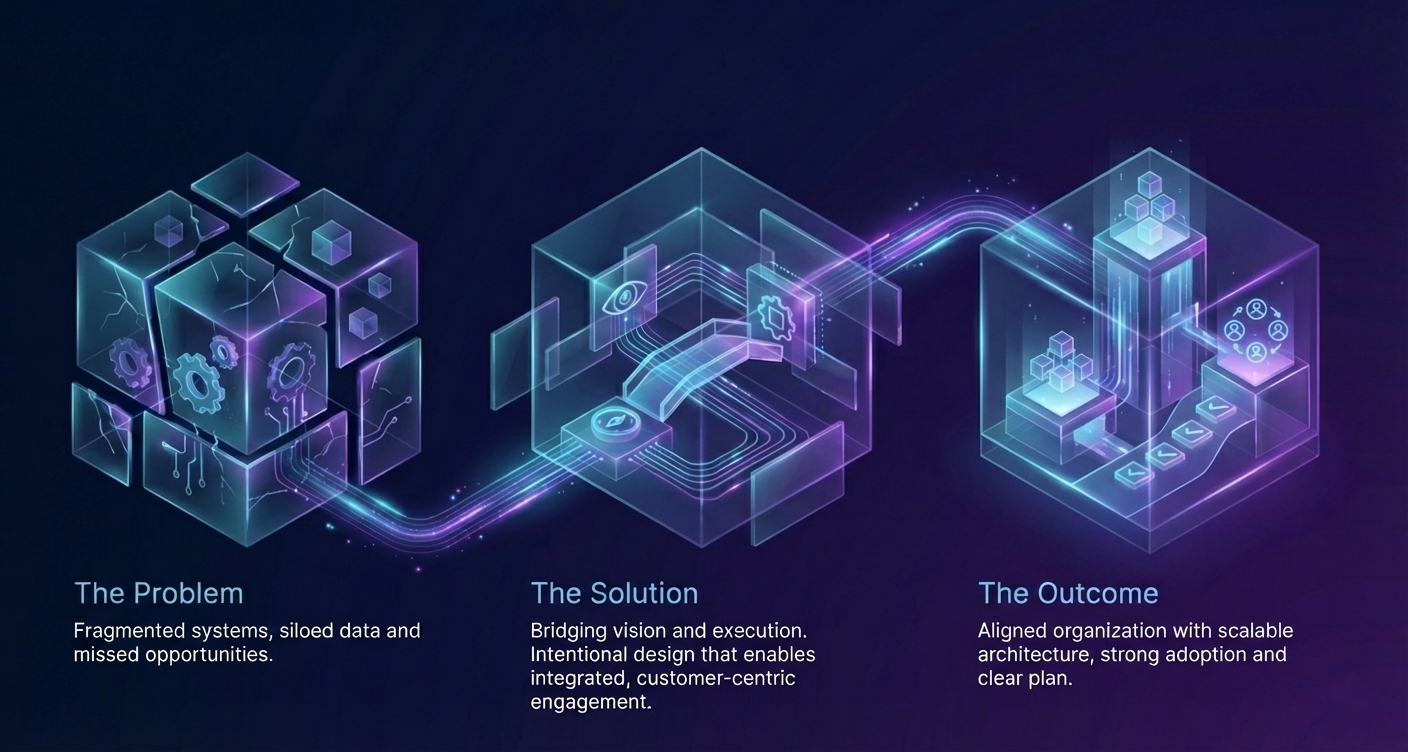
When realized, CRM strategy and blueprinting turn uncertainty into action:
- Leaders gain a validated vision and a focused set of priorities that guide investment where it matters.
- Teams align on roles, processes, and governance, supported by an integration approach and phased roadmap that reduces risk.
- The program provides realistic expectations around cost, timing, and potential pitfalls.
The outcome is an aligned organization with scalable architecture, strong adoption readiness, and a practical implementation plan, backed by leadership and optional support to carry it through delivery.
Setting Your CRM strategy in Motion
If you are:
- Planning a new CRM initiative or major upgrade
- Struggling with fragmented systems and inconsistent customer experiences
- Unsure how to connect your growth strategy with practical, executable CRM decisions
…our CRM Engagement Strategy and Blueprinting Services are designed for you. Reach out to us!
book a demo

