


Blog Details

Marketing in the Age of AI

How Salesforce Applies Autonomous Agents and Unified Data to Marketing Operations
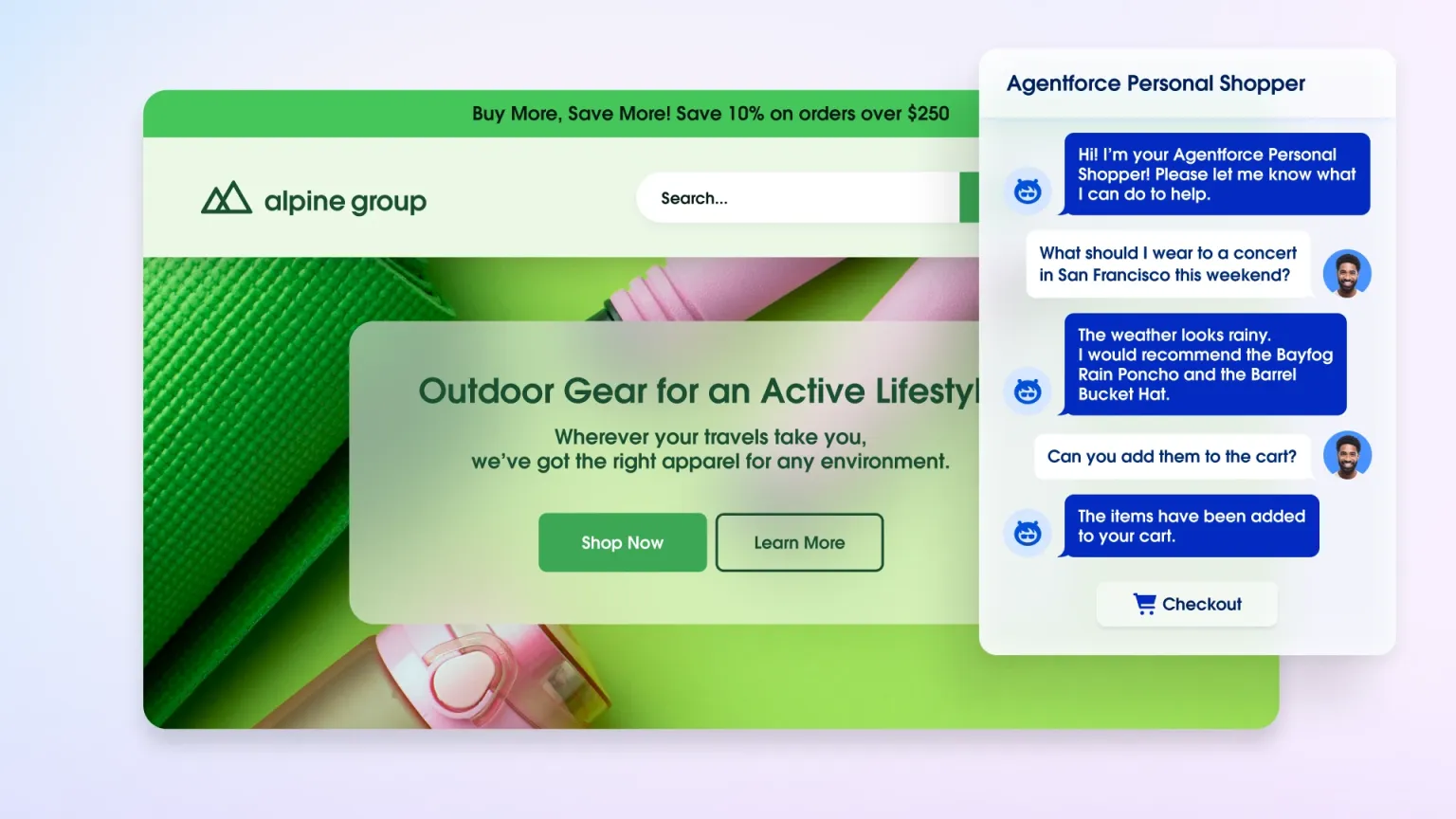
The foundation of modern marketing has shifted. Customers expect timely, relevant interactions across multiple channels, yet many organizations struggle to deliver personalization at scale and manage the necessary data. Salesforce has incorporated agentic AI capabilities across its marketing offerings, shifting the focus from static campaign management toward continuous, data-driven customer engagement.
Rather than presenting AI as a single add-on, Salesforce embeds agentic and predictive AI across Marketing Cloud and Data Cloud and surfaces those capabilities through its agent framework. This integration helps marketers work with greater efficiency and precision. AI-enabled marketing has become an expected capability rather than an optional experiment.
What Is AI-Driven Marketing on Salesforce?
AI-driven marketing on Salesforce operates through two primary mechanisms: agentic AI that automates aspects of campaign execution within defined guardrails, and predictive intelligence that informs strategic decisions.
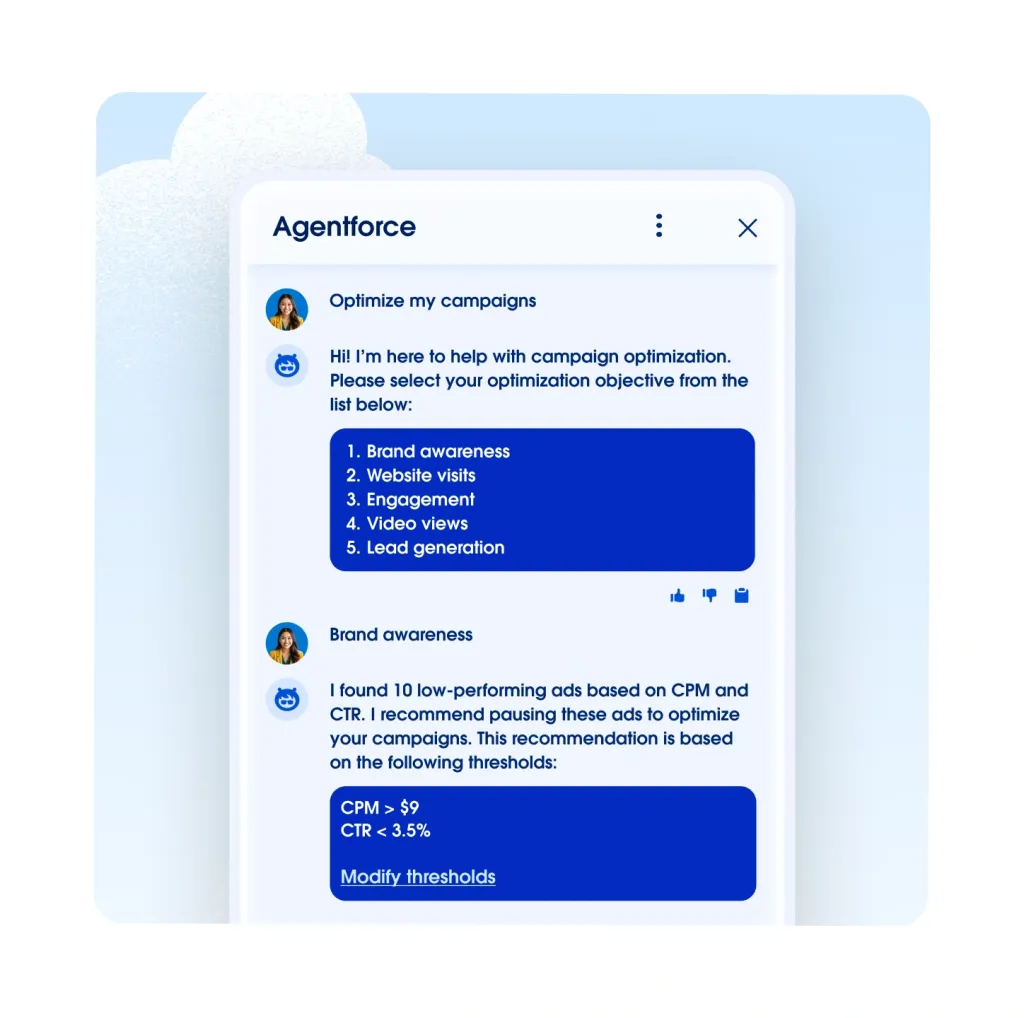
Agent capabilities represent the latest evolution. Using Agentforce capabilities within the marketing ecosystem, agents can assist in generating campaign briefs, suggesting journey structures, and proposing optimizations aligned to business goals. Rather than requiring manual definition of every single step, an agent can interpret an objective such as “increase awareness among top-tier customers” and propose audience segments, content drafts, and channel recommendations. These agent recommendations can be executed through automated flows or require human approval depending on configured governance. Agents learn from results and can suggest iterative changes over time.
Predictive intelligence is provided through Einstein. Einstein supports engagement scoring, send-time optimization, and content recommendations. These capabilities inform decision-making while keeping humans in control. Marketers set strategy and Einstein supplies actionable signals to improve execution.
Together, these form a system where AI handles execution and optimization while marketers focus on strategy, creative direction, and relationship building.
Core Capabilities: What AI-Powered Marketing Can Do
Campaign Creation and Management
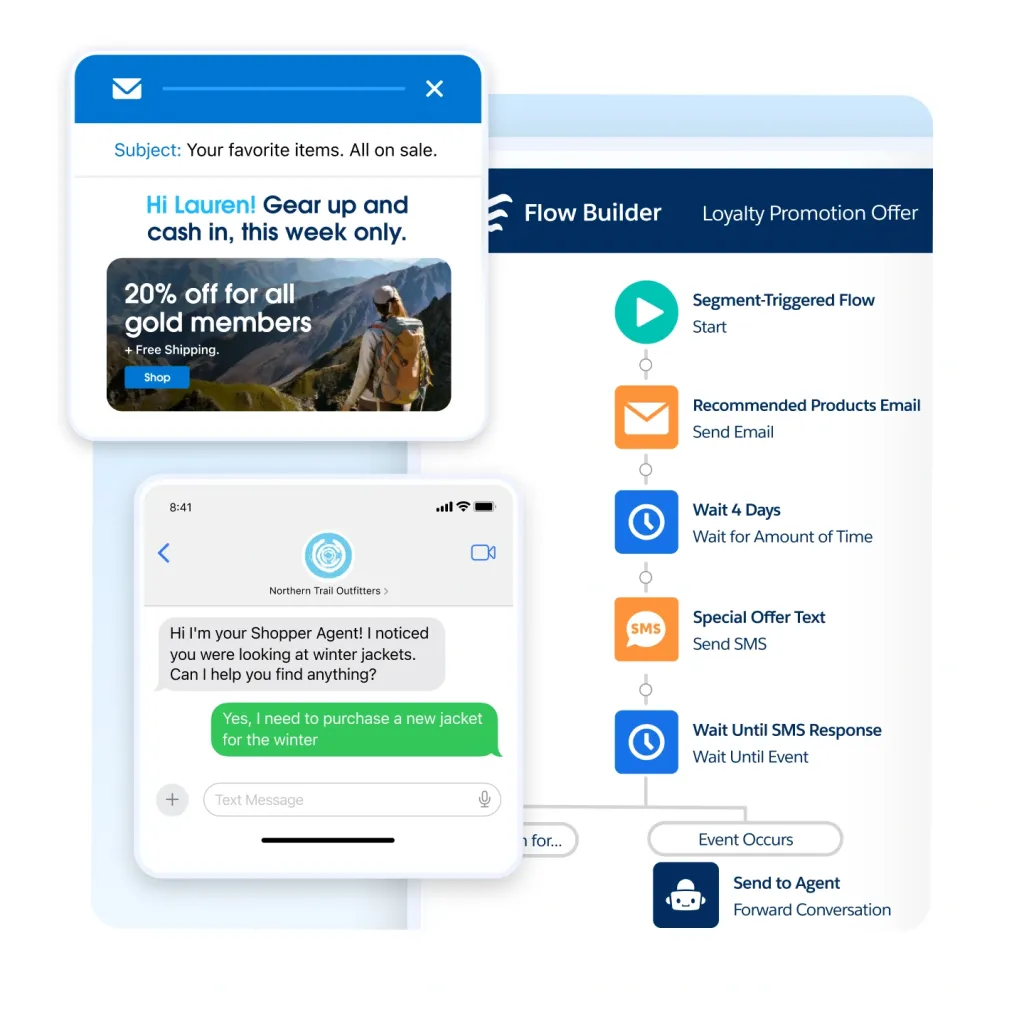
Agent capabilities can generate campaign briefs informed by business objectives and historical performance. Once a campaign is launched, agents can monitor performance continuously, surface recommended adjustments such as send-time changes or content variants, and where configured, trigger automated rules or flag items for review.
Lead Qualification and Nurturing
AI models dynamically assess lead fit and readiness based on real-time behavior signals, and can automate nurturing steps within predefined workflows via email, chatbots, and targeted messaging, or they can escalate to human sales follow-up when appropriate. This reduces the risk of qualified leads being neglected due to manual bottlenecks.
Content Generation and Optimization
Einstein can generate email copy, subject lines, and landing page text from prompts while applying brand constraints where configured. Content selection tools can then surface the best-performing asset variant for specific subscribers, enabling dynamic message adaptation across segments.
Omnichannel Engagement Orchestration
Unified customer data flows across email, SMS, push notifications, web messaging, and third-party messaging apps such as WhatsApp where supported. Engagement frequency caps and intelligent prioritization prevent over-contact while ensuring consistent messaging adapted to channel-specific requirements.
Technical Considerations and Implementation
Data Foundation
The effectiveness of agent capabilities depends on data quality. Audit customer data for completeness and accuracy before deployment. Data Cloud integration requires careful identity resolution to stitch together customer interactions across websites, apps, and purchase history into unified profiles.
Governance and Guardrails
The Einstein Trust Layer provides data masking, logging, model isolation, and tools to support compliance with data residency requirements where configured. Define approval checkpoints for campaigns that exceed risk thresholds. Establish clear rules for what agent actions can be automated and which require human review.
Training and Change Management
Teams move from task execution toward oversight and strategy. Invest in training on agent capabilities, prompt engineering, and platform navigation. Salesforce training and experienced implementation partners can help tailor programs to specific use cases.
Integration Capabilities
Agentforce
Agentforce capabilities integrate with Sales Cloud, Service Cloud, and Commerce Cloud, creating seamless handoffs between functions. Marketing data flows into sales pipelines, enabling sales reps to see engagement history and recommended next steps. Service interactions can inform retention campaigns targeting at-risk customers.
Mulesoft
MuleSoft and API management simplify connections to external systems and legacy platforms, enabling cleaner data flows into Data Cloud and reducing the need for custom development. LinkedIn and other ad integrations support direct sync of customer segments and company lists for ad targeting, with conversion data flowing back to inform future segmentation.
The Operational Reality
AI-driven marketing does not eliminate the need for human judgment. Agent capabilities excel at execution and optimization within defined parameters, but they do not replace strategic thinking around market positioning, competition, or brand evolution. The most effective implementations treat AI as an amplification layer where marketers set strategy and establish brand voice while AI handles scalable execution under human control.
AI agents work best with clear, measurable objectives. Vague goals such as “increase engagement” are harder to operationalize than specific targets like “increase email open rates by 15% for the Q4 campaign”. Results depend equally on data quality. Agents trained on incomplete or inconsistent customer data will produce limited recommendations.
Building Your Path Forward
Organizations beginning this transition should start with a realistic assessment of current capabilities and pain points. Which manual processes consume the most time? Where do delayed insights impact decisions? Where does personalization fall short at scale?
Pilot programs focused on specific use cases such as cart abandonment recovery, lead nurturing, or seasonal campaigns allow teams to build confidence before broader rollout. Invest in data quality up front: a thorough audit followed by cleansing and mapping ensures agent capabilities have reliable inputs and enables more sophisticated segmentation as capabilities expand. The shift from execution to strategic oversight can improve job satisfaction by freeing time for creative work and relationship building. This mindset change is as important as the technical implementation itself.
Conclusion
Salesforce’s integration of agent capabilities and AI across the marketing platform represents an evolution of AI in business applications. Rather than a novelty, AI becomes a core operational capability for customer engagement. Marketers who adopt these capabilities while maintaining strategic oversight and brand accountability can become more productive, personalize at scale, and respond to real-time customer signals.
The competitive advantage belongs to organizations that can act on data fastest. Salesforce's platform enables that speed through automation, unified data, and intelligent optimization.
If you're considering how to position your organization for AI-driven marketing, we can help you assess current capabilities, identify high-impact use cases, and implement a roadmap that balances automation with strategic control. Contact us to explore how Salesforce can transform your marketing operations.
book a demo

