


Blog Details

Anthropic and Salesforce: Claude Inside Your CRM, Salesforce Inside Claude

For most of the past two years, “AI in Salesforce” has meant one thing: models working behind the scenes of Salesforce. The partnership between Anthropic and Salesforce changes that picture. Claude now sits at the centre of Salesforce’s agent products, and Salesforce is also available inside Claude as a plugin. For business teams, the question is no longer whether to use AI, but where work should begin and where it should be governed. For developers, it is a new way of building on the platform.
How the Partnership Evolved
The relationship did not start with a single announcement. In October 2025, the two companies expanded their partnership to deliver enterprise-grade AI for regulated and data-sensitive industries, making Claude a foundational model for the Agentforce 360 Platform. That phase focused on trust: Claude was made available to Agentforce customers without their data leaving the Salesforce environment.
In August 2026 came the next step, called Claudeforce. It runs in two directions: Claude is embedded across Agentforce, and Salesforce data and workflows are brought into Claude through a plugin.
Claude Inside Salesforce
On the Salesforce side, Claude now plays a central role in the agent stack. It is the reasoning model behind the Atlas Reasoning Engine, powers Agentforce Vibes and Agentforce Coworker by default, and is available in Agent Builder. Slack follows the same pattern, with Claude becoming the default model behind Slackbot.
The deployment path matters as much as the model. Claude traffic is contained within the Salesforce virtual private cloud, and Anthropic’s Amazon Bedrock-hosted models run within the Agentforce 360 Platform. For banks, healthcare providers and public bodies, this is often the difference between a pilot that stays a pilot and a solution that reaches production.
Salesforce Inside Claude
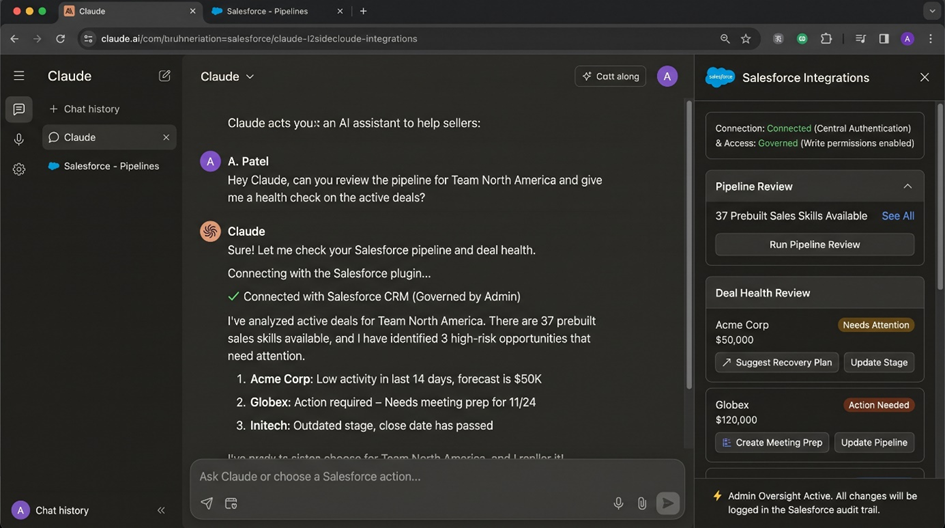
The second direction is the newer one. Salesforce in Claude is a plugin that gives sellers 37 prebuilt sales skills inside Anthropic’s own interface, covering meeting preparation, deal health review and pipeline review, with the ability to update pipelines through governed actions. Administrators connect it once, with central authentication and permissions.
An assistant that only reads a pipeline is a demo. One that can update it needs permissions, an audit trail and an administrator who can revoke access. That governance layer is what makes this relevant for production use.
Claude Code, MCP and the Salesforce Developer
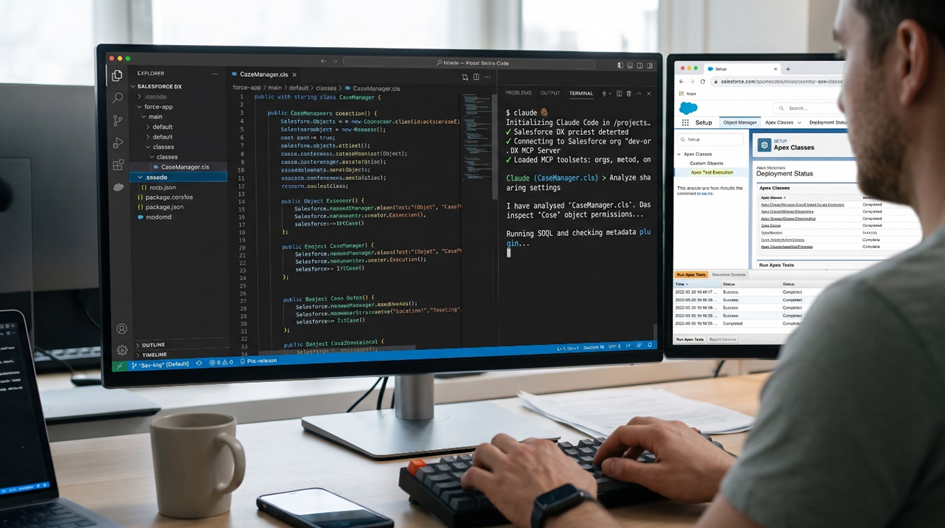
Everything above is aimed at business users. The partnership also matters on the developer side, where the effect on day-to-day delivery is more immediate. Salesforce itself works this way: it is deploying Claude Code across its global engineering organisation to augment developer workflows and increase productivity.
What is MCP, and why doesit matter?
The Model Context Protocol (MCP) is an open standard that lets an AI client call tools and read context from external systems in a consistent way. For a Salesforce project, this means Claude Code is not guessing from a pasted snippet. It can work against a real org, with the permissions you give it.
Two ways to connect ClaudeCode to Salesforce
- Salesforce DX MCP Server. An open-source local server built by the team behind the Salesforce CLI, which lets an agent interact with the orgs you have authenticated through the CLI. It is organised into toolsets (for example orgs, metadata, data, code analysis and LWC), so you enable only what a given task needs.
- Salesforce-hosted MCP servers. These use OAuth-based access and do not require a local CLI, which suits users who are not developers. The same principle applies: the connection inherits the access you grant, not more.
The Salesforce Development plugin for Claude Code
The newest piece is a plugin from Salesforce. It detects your Salesforce DX project and gives Claude Code Salesforce-specific skills and org context through pre-configured Salesforce-hosted MCP servers. According to the Winter ’27 developer notes, the agent can write and run Apex tests, analyse debug logs, run SOQL queries, configure sharing, scan code with Code Analyzer, and validate and deploy metadata. A bundled Apex and SOQL language server gives the agent the same code intelligence as your IDE.
A minimal project configuration looks like this:
{
  "mcpServers": {
    "Salesforce DX": {
      "command": "npx",
      "args": ["-y", "@salesforce/mcp",
               "--orgs", "MY_SANDBOX_ALIAS",
               "--toolsets", "orgs,metadata,data,code-analysis"]
    }
  }
}
Where it helps on a real project
- Understanding an inherited org. Retrieve metadata, trace dependencies and summarise what a legacy flow or Apex class does before anyone changes it.
- Test-driven Apex. Generate tests, run them against a scratch org or sandbox, read the failures and iterate.
- Quality gates. Run Code Analyzer on every change and fix findings before the pull request.
- Repetitive configuration work. Metadata for fields and permission sets, data-loader mappings and migration scripts follow clear patterns that an agent handles well.
- Documentation. Keep technical documentation in step with the code, which is often the first thing to slip.
Closing the loop with Agentforce
The connection also works in the other direction. An Agentforce agent can be made available to any MCP client, such as Claude, by adding it as a tool on a custom MCP server. Teams can build an agent once, govern it in Salesforce, and reach it from several interfaces.
What Changes for Salesforce Teams

At Uni5 Consulting, we see five practical implications:
- Data quality becomes visible. Reasoning over live CRM data exposes every inconsistent field, duplicate account and outdated opportunity. Clean data is the foundation, not an afterthought.
- Permissions become the real design work. When an agent can act on records, sharing rules, field-level security and approval paths define what “safe” means.
- Configuration first still applies. Before building custom agent logic, check what Agent Builder, standard actions and the new plugin already cover.
- Slack becomes part of the architecture. With Claude at the centre of the Slack experience, conversations and CRM records belong in the same design discussion.
- Developer tooling needs ground rules. Our delivery model is senior-led, so we treat tools such as Claude Code as accelerators for experienced people, not replacements for them. In practice, that means working in sandboxes first, enabling only the toolsets a task requires, and sending every change through the normal pull request, code review and deployment pipeline.
Questions to Ask Before You Adopt
- Which processes would genuinely benefit from an agent that can reason and act, and which are better served by a well-built flow?
- Who owns the governance model: permissions, audit, and the process for revoking access?
- Which teams should pilot first, and what would success look like after 90 days?
- Is the underlying data ready for an agent to rely on?
- What are the rules for AI-assisted development on the project: data handling, org access and code review?
We recommend starting with one well-bounded use case, such as pipeline review, case summarisation or AI-assisted test generation, then expanding in phases. This keeps value early and risk controlled. Final decisions about scope and rollout always remain with your organisation.
Conclusion
The Anthropic and Salesforce partnership shows that the future of enterprise AI is not a single interface. Work will start in conversation, in Slack, in Claude and in the developer’s terminal, and will be executed through the data, logic and governance of the Salesforce platform. The organisations that benefit most will be those that treat data quality, access models and delivery practices as seriously as the AI itself.
If you are exploring how Agentforce and Claude can work in your organisation, or how Claude Code could fit into your Salesforce delivery, Uni5 Consulting can help you assess where to start and how to implement it with the right controls. Contact us to discuss the practical options.
book a demo

